Work — Institutional finance

Wells Fargo Subscription Finance

A lending book bought wholesale off a European bank in wind-down, dropped into a US balance sheet, and pointed at private equity sponsors who had not chosen it. The work: stop selling a facility and start selling a relationship — in decks, in diligence, and in every coverage conversation.

ContextWells Fargo — subscription (fund) finance, within Investment Banking
RoleOrigination — sales and marketing for the desk. Work by Strategic Pixel’s founder, prior to founding the agency
SituationIntegration and rebranding of an acquired capital-call lending portfolio
DisciplinesCategory positioning, narrative architecture, pitch collateral, sales enablement

The situation

You cannot buy a client list. You inherit one and then have to earn it.

In 2012 Wells Fargo acquired WestLB’s subscription finance portfolio — roughly $6 billion in commitments and close to $3 billion in outstanding loans — and hired the team that had built it, including Dee Dee Sklar, WestLB’s head of subscription finance, to anchor the platform.1, 2 Overnight the bank went from a participant in capital-call lending to one of its largest balance sheets.

What it did not acquire was conviction. Every sponsor in that book was a relationship someone else had built, at an institution that was being wound down. A general partner looking at a facility renewal notice from a new lender is not asking about pricing first. They are asking a much blunter question: is this bank going to still be in this business when I raise Fund VII?

So the mandate was never lead generation. It was retention, and then expansion, of a book that had every reason to be nervous.

~$6B Capital commitments in the acquired WestLB subscription finance portfolio. Public record — 2012
~$3B Outstanding loans transferred with the portfolio. Public record — 2012
Team WestLB’s subscription finance group hired alongside the book, anchoring a dedicated execution capability. Public record — 2012

The challenge

The product had been commoditised into a line item.

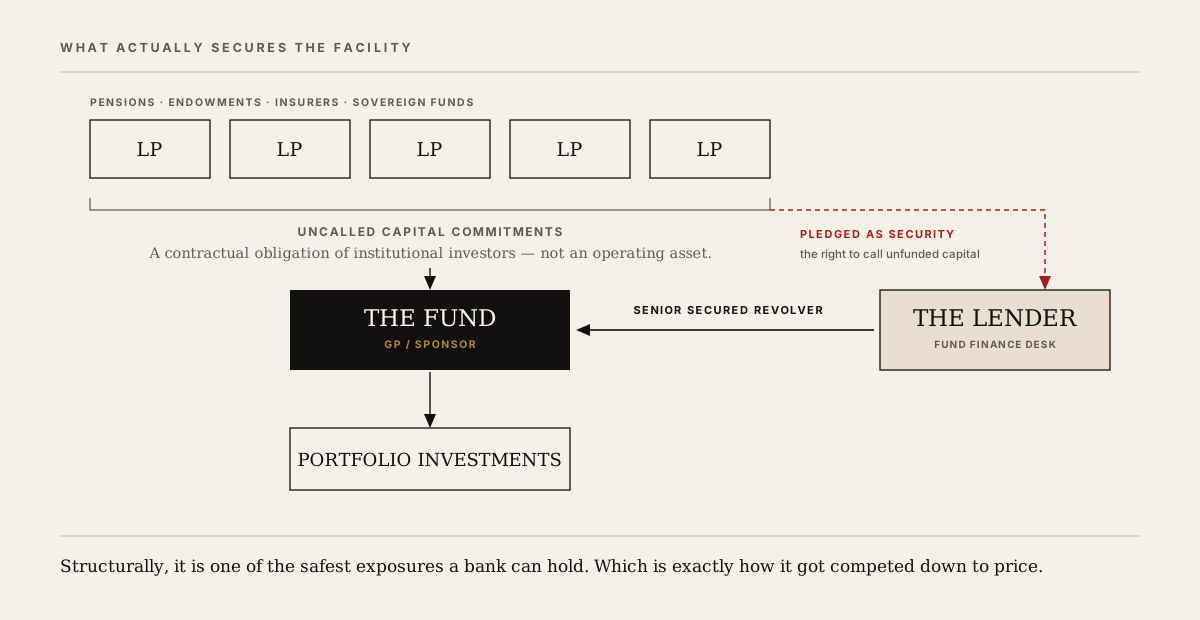
A subscription credit facility is a senior secured revolving line collateralised by the uncalled capital commitments of a fund’s limited partners.3 Structurally it is one of the safest exposures a bank can hold: the collateral is a contractual obligation from institutional investors, not an operating asset that can deteriorate.

That safety is exactly what turned it into a commodity. When everyone agrees the risk is low, the only remaining conversation is spread, tenor, and advance rate. Facilities were shopped on a grid, negotiated by fund CFOs and administrators, and renewed or moved on basis points. The lender was interchangeable by design.

Two problems compound in an acquisition scenario. A commodity product gives a sponsor no reason to stay with a lender they did not choose — and a book assembled by another institution arrives with no shared story. Different vintages, different documentation habits, different pitch materials, different assumptions about what the product is even for. Nothing in the collateral said “one platform.”

Diagram: five limited partners hold uncalled capital commitments to the fund. The commitments and the right to call them are pledged to the lender as security. The lender extends a senior secured revolver to the fund, which deploys into portfolio investments.

The structure behind the product — collateral is a contractual obligation of institutional investors, not an operating asset.

The reposition

Not debt on the fund. Infrastructure inside it.

The move was to stop describing the facility as borrowing and start describing what it actually does to how a fund operates.

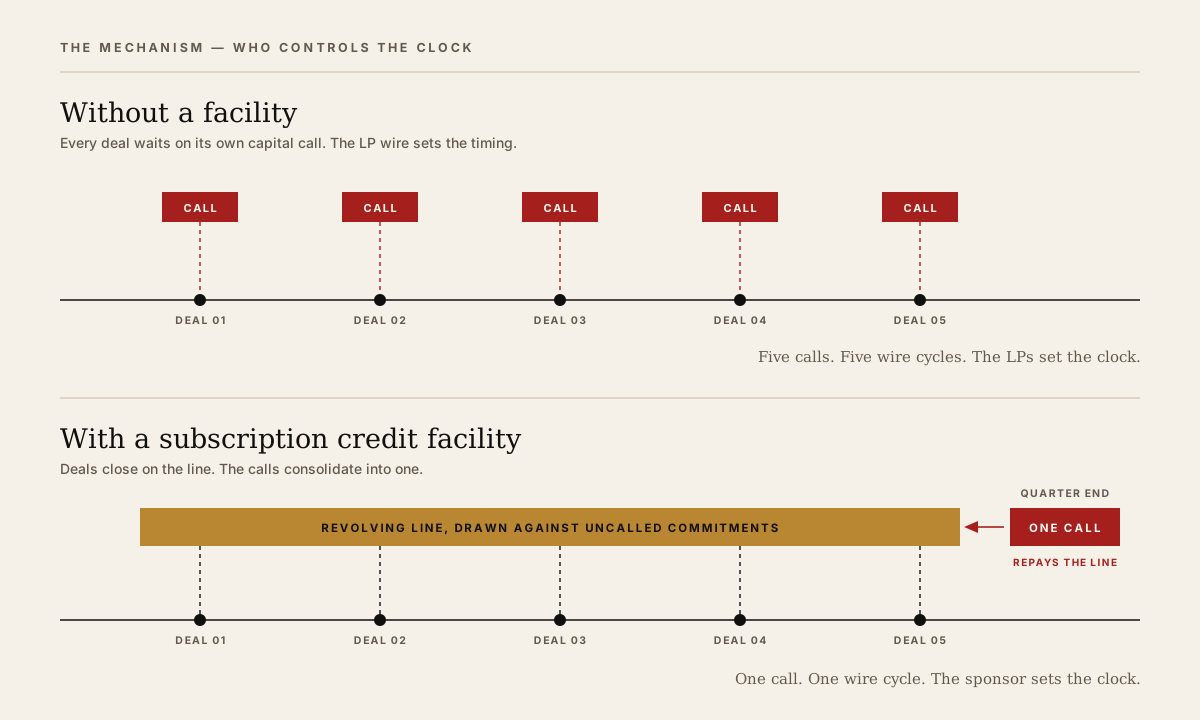
A capital-call line lets a sponsor execute on a deal timeline instead of an LP wire timeline. It consolidates a scatter of small capital calls into fewer, larger, more predictable ones — which is a service to the limited partners, not a cost imposed on them. And because the money is deployed before the call goes out, it changes the shape of the fund’s cash flows and therefore the arithmetic of its returns. That is not a liability. That is operating machinery.

Reframed that way, the buying question changes with it. A grid is compared on price. Machinery is evaluated on whether the people running it will be there next year, understand your LP base, and pick up the phone in a stressed quarter. Those are questions a large, committed, permanently staffed platform wins — which is precisely what the acquisition had just created.

Not: here is our pricing grid. But: here is how your fund runs on this.
Two stacked timelines. Without a facility, five deals each trigger their own capital call to limited partners. With a subscription credit facility, all five deals close on a drawn revolving line and the calls consolidate into one quarter-end call that repays the line.

The argument in one image — the kind of visual that displaced the pricing grid at the front of the conversation. Drawn for this page, not an artifact of the engagement.

The approach

Four decisions that changed what the materials argued.

01 — Lead with permanence, not price

Pitch materials were re-sequenced to open on the scale and stability of the consolidated platform rather than the pricing grid. For a sponsor weighing whether to leave a facility where it is, the first unanswered question is whether the lender is a permanent home or a warehouse. Answer it on the first slide and every subsequent slide is read differently.

02 — Replace the pricing sheet with the mechanism

Dense debt-pricing tables gave way to a single visual of where the facility sits inside a fund’s drawdown cycle — when capital calls happen, where the line bridges them, and how that changes the timing of deployed capital. One diagram carries more persuasion than a page of tenor and spread, because it shows the sponsor their own operating calendar.

03 — Move the conversation to the LP base

Coverage discussions were reframed around the composition, quality, and concentration of the limited partner base — the thing that genuinely determines whether the facility is sound. That reframe puts the bank and the sponsor on the same side of the analysis, reading the same investor roster, instead of facing each other across a term sheet.

04 — Treat the facility as an entry point

The subscription line was positioned as the first instrument in a multi-year coverage relationship rather than a standalone transaction to be won and re-won annually. It reframes a renewal from a competitive event into a continuation — and gives the sponsor a reason to consolidate more of the fund’s balance sheet in one place.

The blueprint

Integration only pays off when the story is unified too.

01

Portfolio acquired

A book, a team, and a market position arrive at once — with no shared narrative attached to any of it.

02

Collateral unified

One category story, one visual system, one set of pre-approved modules the origination team can assemble against any sponsor.

03

Dialogue reframed

Coverage conversations shift from loan terms to the sponsor’s LP base, drawdown cadence, and multi-year plan.

04

Commitments held and grown

Renewals stop being competitive events. The platform becomes the default rather than the incumbent.

On what is claimed here

The transaction facts above — the 2012 WestLB portfolio acquisition, the commitment and loan figures, the team hire, and the structure of a subscription credit facility — are public record and sourced below.

The diagrams on this page were drawn for this write-up. They explain how the product works and what the repositioning argued; they are not reproductions of Wells Fargo materials.

The positioning, collateral, and conversational approach described on this page is an account of method: how a complex balance-sheet product was argued to institutional buyers. It is presented as professional background and approach, not as a claim of attributed business results. No performance metrics, revenue impact, or win rates are asserted, and none should be inferred. Wells Fargo is a former employer of Strategic Pixel’s founder, not a client of the agency; all marks belong to their owners.

  1. American Banker — “Wells Fargo to Acquire Subscription Finance Business”
  2. RTTNews — “Wells Fargo To Buy WestLB’s Subscription Finance Portfolio”
  3. Asset Securitization Report — facility structure and collateral

In practice

What an account-based motion looks like in a market of a few hundred buyers.

Fund finance is not a volume market. The universe of sponsors worth covering is small, concentrated, and almost entirely reachable by name. That inverts the usual marketing arithmetic: reach is trivial, relevance is everything.

Proprietary insight as the opener

Distribute the bank’s own read on LP liquidity, call cadence, and facility utilisation directly to fund CFOs and sponsors. In a market this narrow, a genuinely proprietary data point is a better door-opener than any campaign.

Modular, pre-approved toolkits

Origination teams get assembled decks, not blank templates — approved narrative modules that can be reordered for a real estate fund versus a buyout fund in an afternoon, without a compliance cycle for every variation.

Presence where the category convenes

Anchor the platform to industry associations and the conference circuit where fund finance is actually discussed. In a relationship market, showing up consistently in the same rooms is the brand campaign.

The takeaway

What transfers to any complex, high-consideration category.

Reframe the unit of value

Commodities are defined by what you sell, not what you make.

The facility never changed. What changed was the unit being compared — from a price on a grid to a capability inside the buyer’s own operation. Every category that has been competed down to price has this same move available.

Integration is a narrative problem

An acquired book arrives without a story.

Balance sheets consolidate on close. Positioning does not. Until one category story exists across every deck and conversation, an acquirer is running two brands and telling the market it bought a book rather than built a platform.

Sell the desk, not the paper

In relationship markets the team is the product.

When the instrument is standardised and the risk is understood, the differentiator is who underwrites it, how fast, and whether they will be there next fund. Naming that explicitly beats competing on a spread you will eventually have to defend.

Why this sits on an agency site Strategic Pixel’s founder spent this period in origination — the sales and marketing end of an institutional lending desk — arguing for a product most people would call unmarketable, to a buyer with no tolerance for decoration. The habits it built — lead with the buyer’s mechanism, make the numbers legible, never oversell what you cannot evidence — are the same ones applied to every engagement now. Including the discipline of clearly separating what is documented from what is claimed, as above.
Keep looking All work →

Your turn

Selling something complex into a category that only talks about price?

Start a project →